


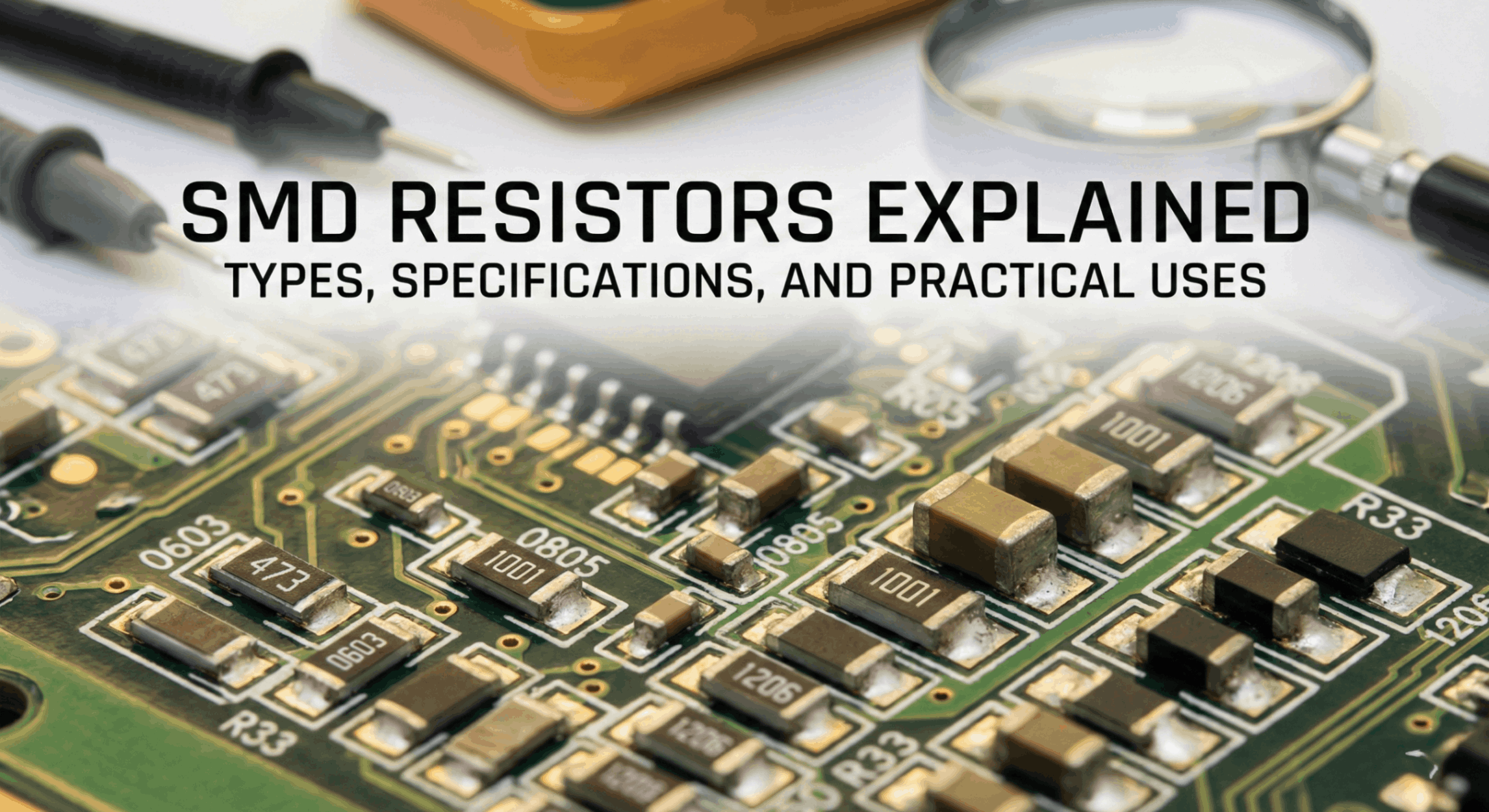
SMD Resistors Explained: Types, Specifications, and Practical Uses
Walking into an electronics components store and hearing terms like “SMD resistor,” “0805 package,” and “thick film versus thin film” can feel overwhelming. Understanding the differences between these tiny components will help you choose the perfect one for your project and avoid costly mistakes.
What Exactly is an SMD Resistor?
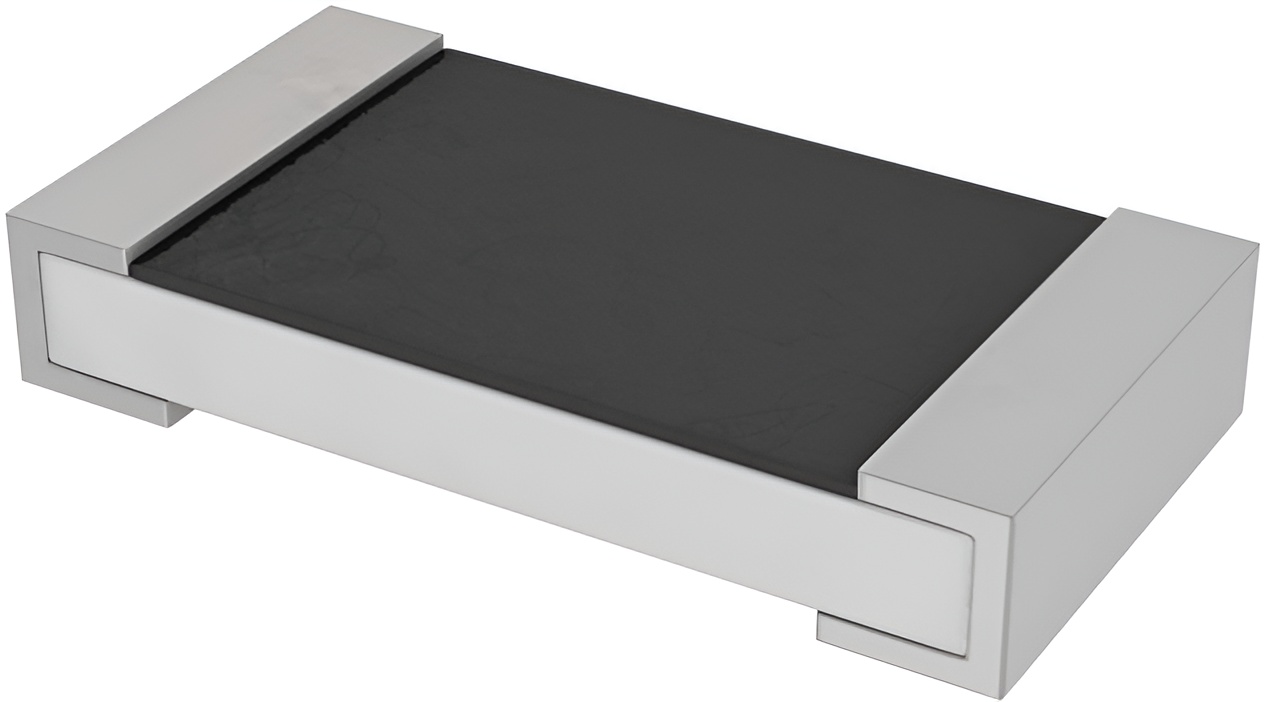
An SMD resistor is a tiny electronic component designed to be mounted directly onto the surface of a printed circuit board (PCB). Unlike traditional through-hole resistors with long wire leads, SMD resistors sit flat against the board, soldered to surface pads.
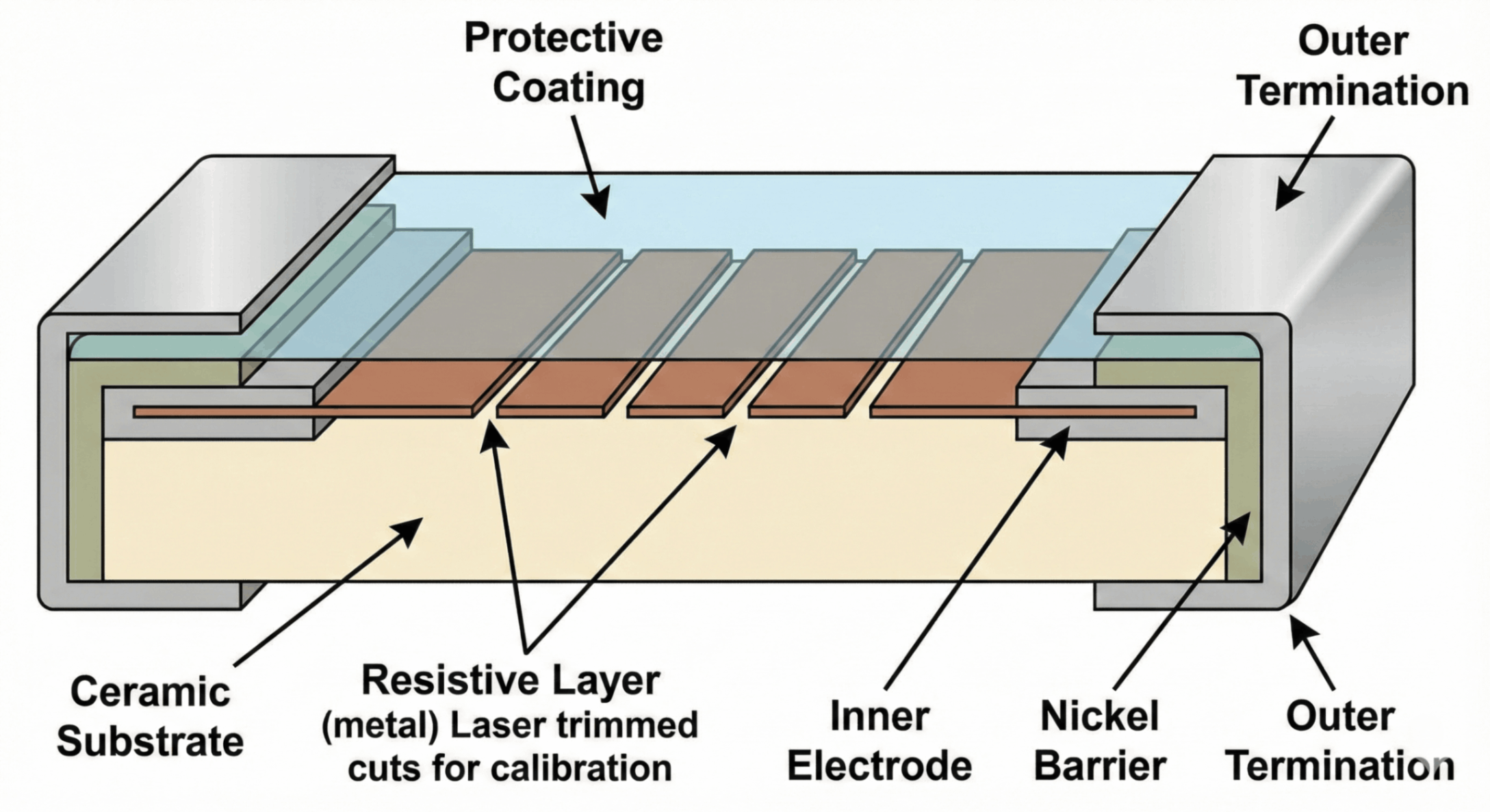
Cross-section showing the layered construction of a typical SMD resistor
Today, your smartphone alone contains hundreds of these miniature components, working silently to manage current, divide voltages, and keep your device functioning. The construction is simple: a ceramic substrate provides the foundation, a resistive layer provides the resistance, metal terminations make electrical connections, and a protective coating shields everything from moisture.
Types of SMD Resistors
By Construction Material
Thick Film Resistors:
The workhorses of electronics, offering cost-effective solutions with ±1% to ±5% tolerances. Ideal for general-purpose circuits, consumer electronics, and applications where reliability and affordability matter most.Thin Film Resistors:
Deliver high precision with ±0.1% to ±1% tolerances and superior temperature stability (25–50 ppm/K compared to 200+ ppm/K for thick film). Ideal for precision instrumentation, medical equipment, and applications where accuracy is critical.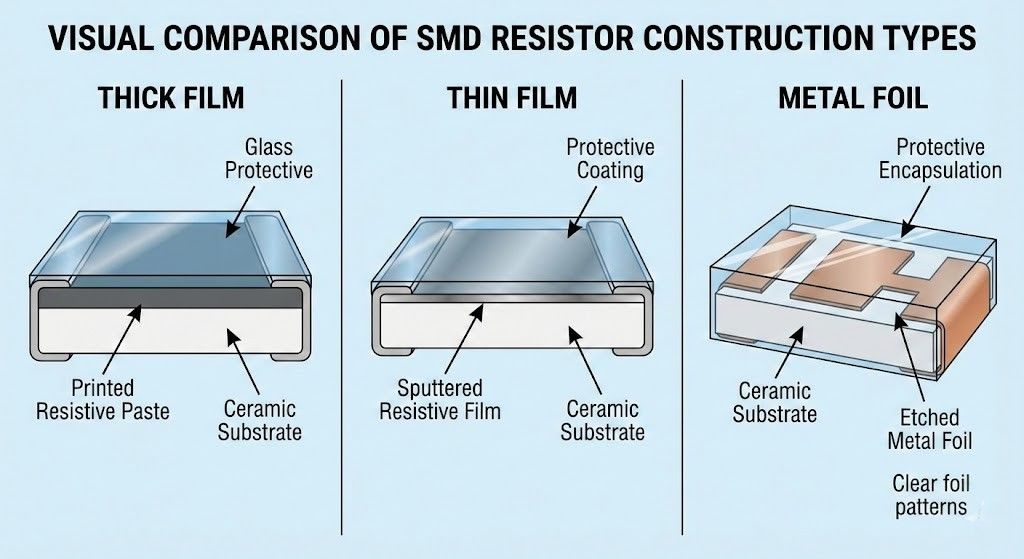
comparison of different SMD resistor construction types
Metal Foil, Metal Oxide & Metal Film Resistors:
Serve specialized needs—offering premium precision for aerospace systems, high-temperature reliability for automotive applications, and low-noise performance for high-fidelity audio equipment.comparison of different SMD resistor construction types
Metal Foil, Metal Oxide & Metal Film Resistors:
Serve specialized needs—offering premium precision for aerospace systems, high-temperature reliability for automotive applications, and low-noise performance for high-fidelity audio equipment.Package Sizes: Understanding the Codes
Package codes like “0805” represent physical dimensions. Here’s what matters practically:
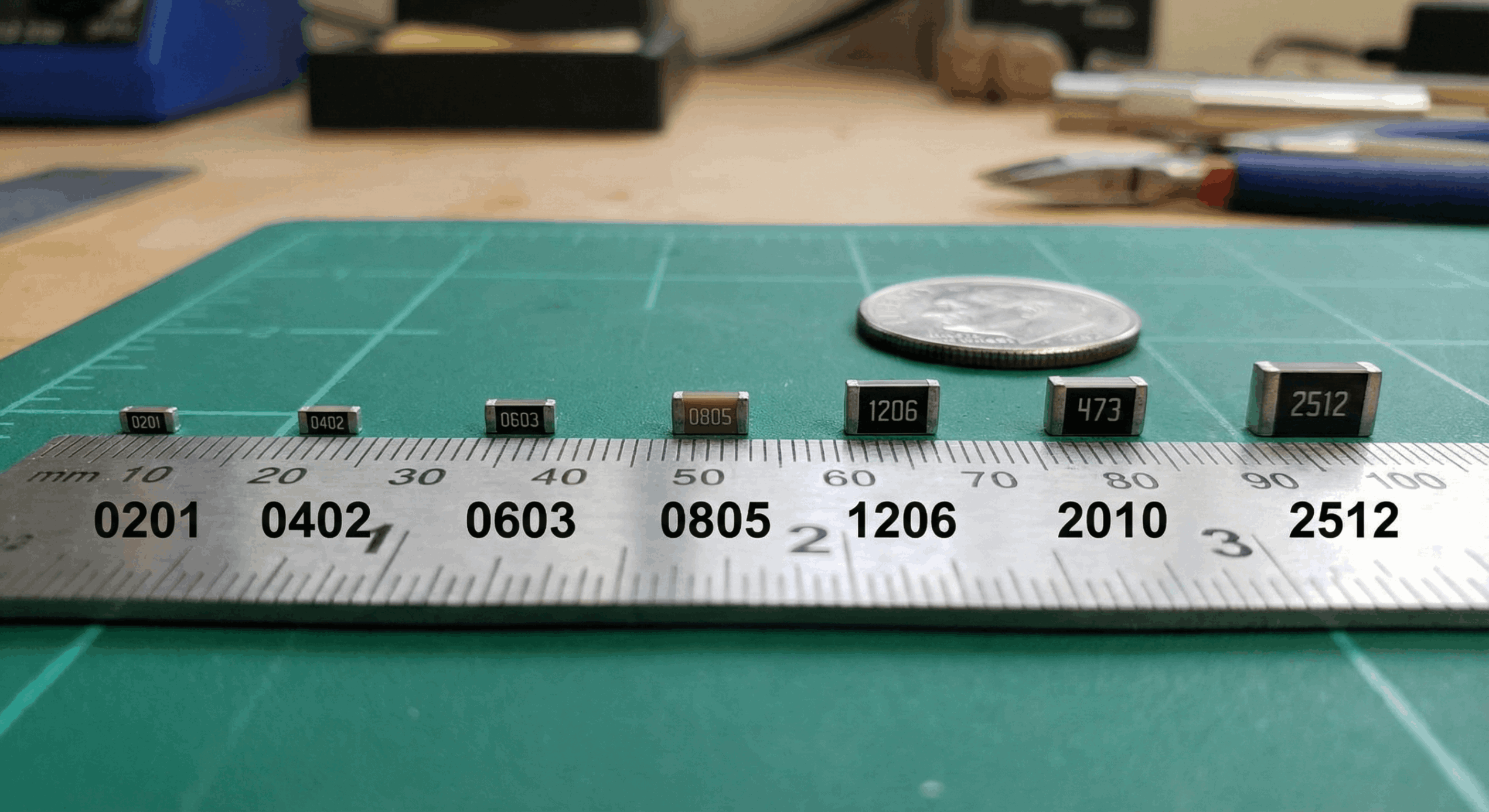
comparison of common SMD resistor package sizes
- 0201/0402: Smartphone-sized, challenging to hand-solder
- 0603 (1.6mm × 0.8mm): Sweet spot for hobbyists-small but hand-solderable
- 0805/1206: General-purpose, easy hand assembly, better power handling (1/8W and 1/4W)
2512: High-power applications up to 1W
Tolerance Levels
±1% tolerance is standard for modern electronics-precise enough for most applications. ±0.1% or better is for precision measurement equipment. Don’t over-specify; save premium components for where they matter.
How to Read SMD Resistor Codes
Reading these tiny markings is essential but challenging.
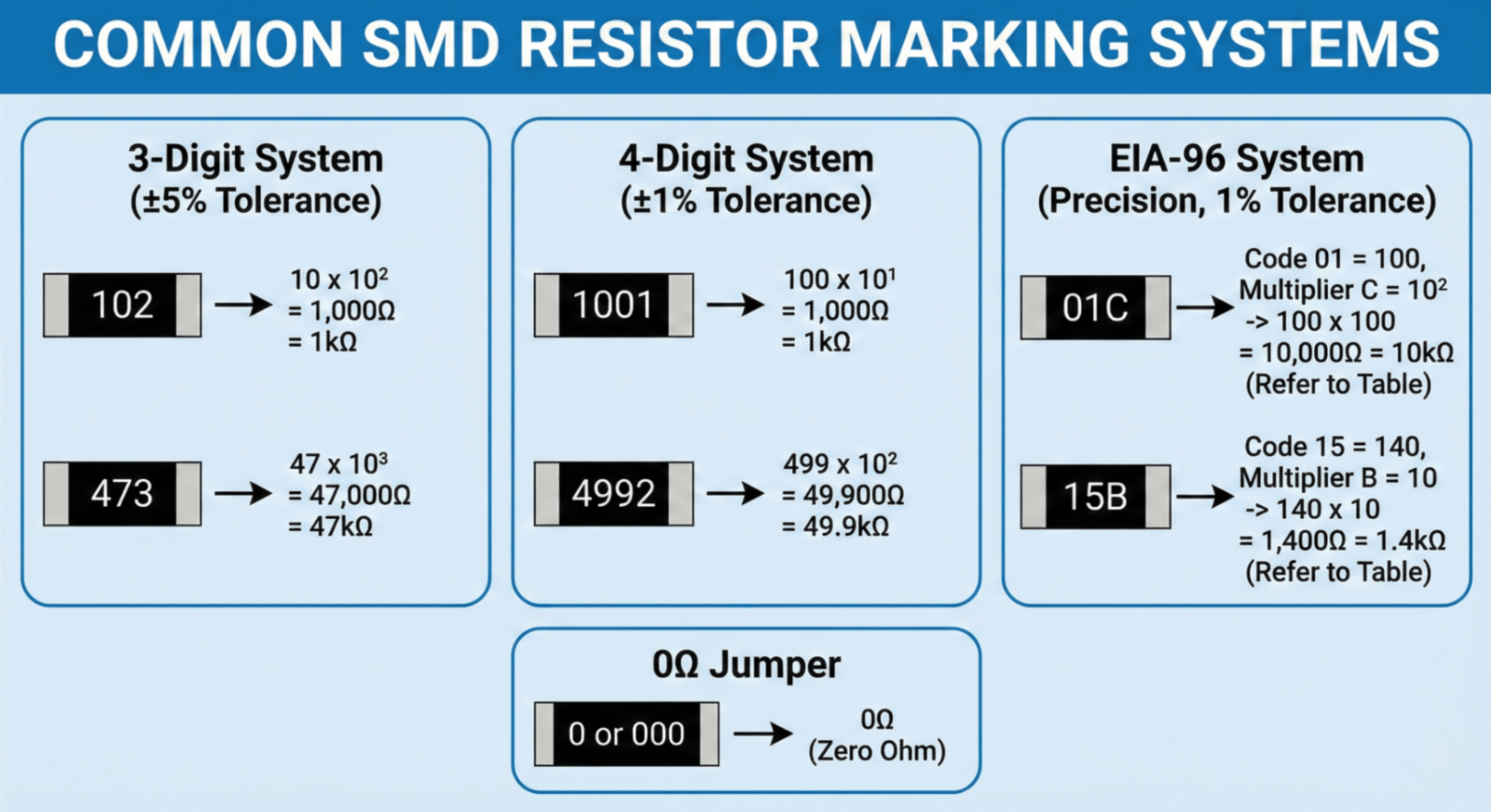
Common SMD resistor marking systems with example
Three-Digit System (Most Common)
First two digits are significant figures, third digit is the number of zeros.
- “473” = 47,000Ω (47kΩ)
- “222” = 2,200Ω (2.2kΩ)
Four-Digit System (Precision)
First three digits are significant figures, fourth is the multiplier.
- “4992” = 49,900Ω (49.9kΩ)
- “1001” = 1,000Ω (1kΩ)
"R" for Decimal Points
- “4R7” = 4.7Ω
- “R33” = 0.33Ω
EIA-96 Code
Two-digit table code + letter multiplier for tiny packages. “01D” = 100kΩ. Requires reference table.
Zero Ohm Resistors
Marked “0” or “000“-function as jumper wires for automated assembly.
Pro Tip:
Use a magnifying glass and ensure good lighting when identifying resistors. If markings are unclear, rely on a multimeter. Keep components organized—very small resistors are often unmarked.Advantages and Limitations
Why SMD Resistors Dominate
Space efficiency enables compact designs fit ten 0603 resistors in the space of one through-hole resistor. Automated assembly makes production faster and cost-effective. Better high-frequency performance with lower parasitic effects. Mechanical stability with no leads to bend-ideal for automotive and industrial applications.
The Challenges
Heat dissipation limitations mean smaller resistors handle less power in real conditions. Manual assembly difficulty frustrates hobbyists-0402 and smaller require specialized tools. Repair challenges arise when identifying and replacing unmarked components on populated boards.
Despite limitations, SMD resistor‘ advantages far outweigh disadvantages in modern electronics.
Common Applications
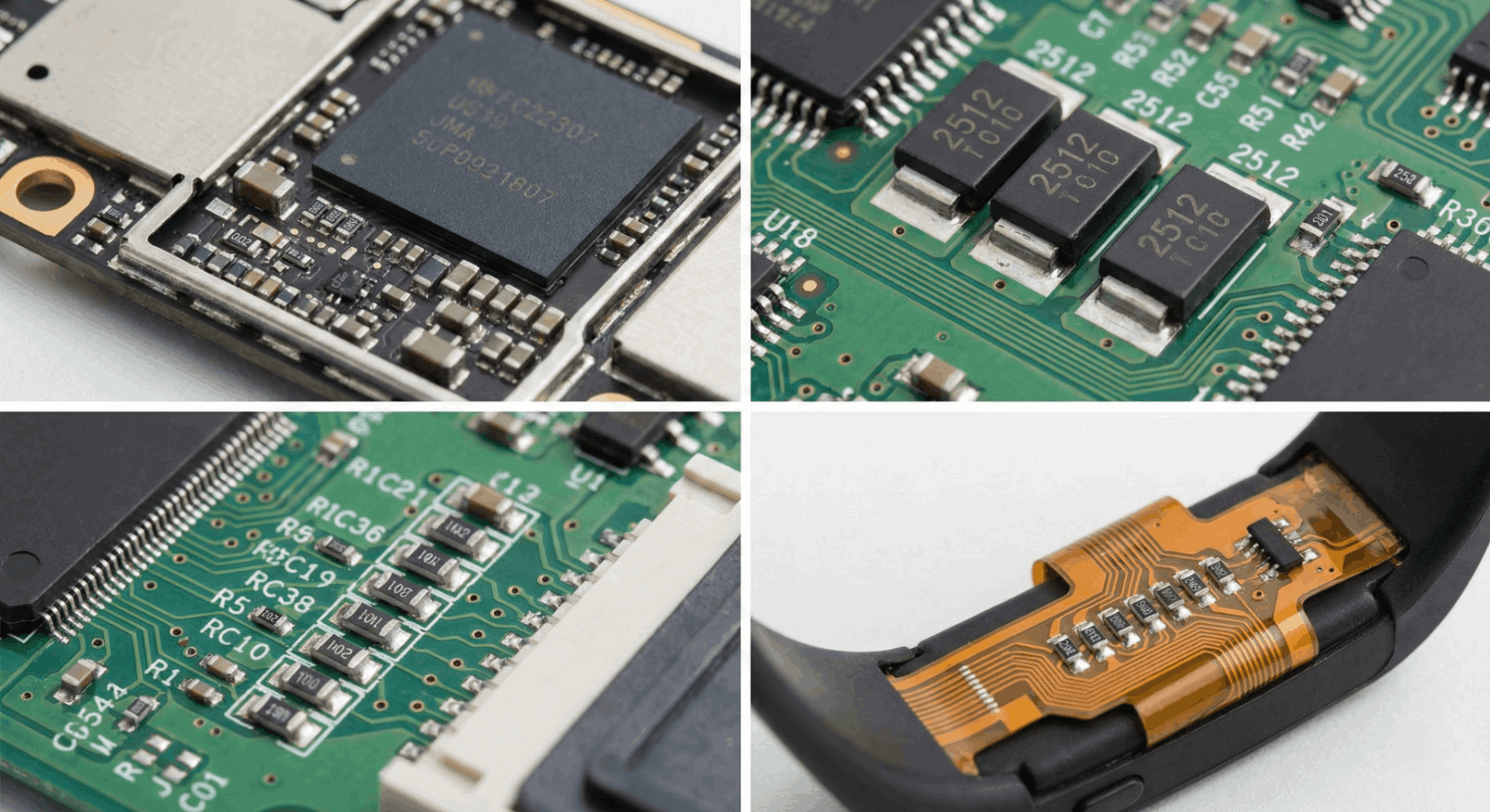
SMD resistors in various application contexts
Everyday Functions:
Current limiting for LEDs, voltage division for power supplies, pull-up/pull-down for digital logic, and current sensing in battery management.Industry Applications:
Smartphones use them for power management and sensors. Automotive electronics require wide temperature ranges (-40°C to +125°C) for engine controls and safety systems. Medical devices demand high precision for monitoring equipment. Industrial controls need ruggedness for harsh environments.Selecting the Right SMD Resistor
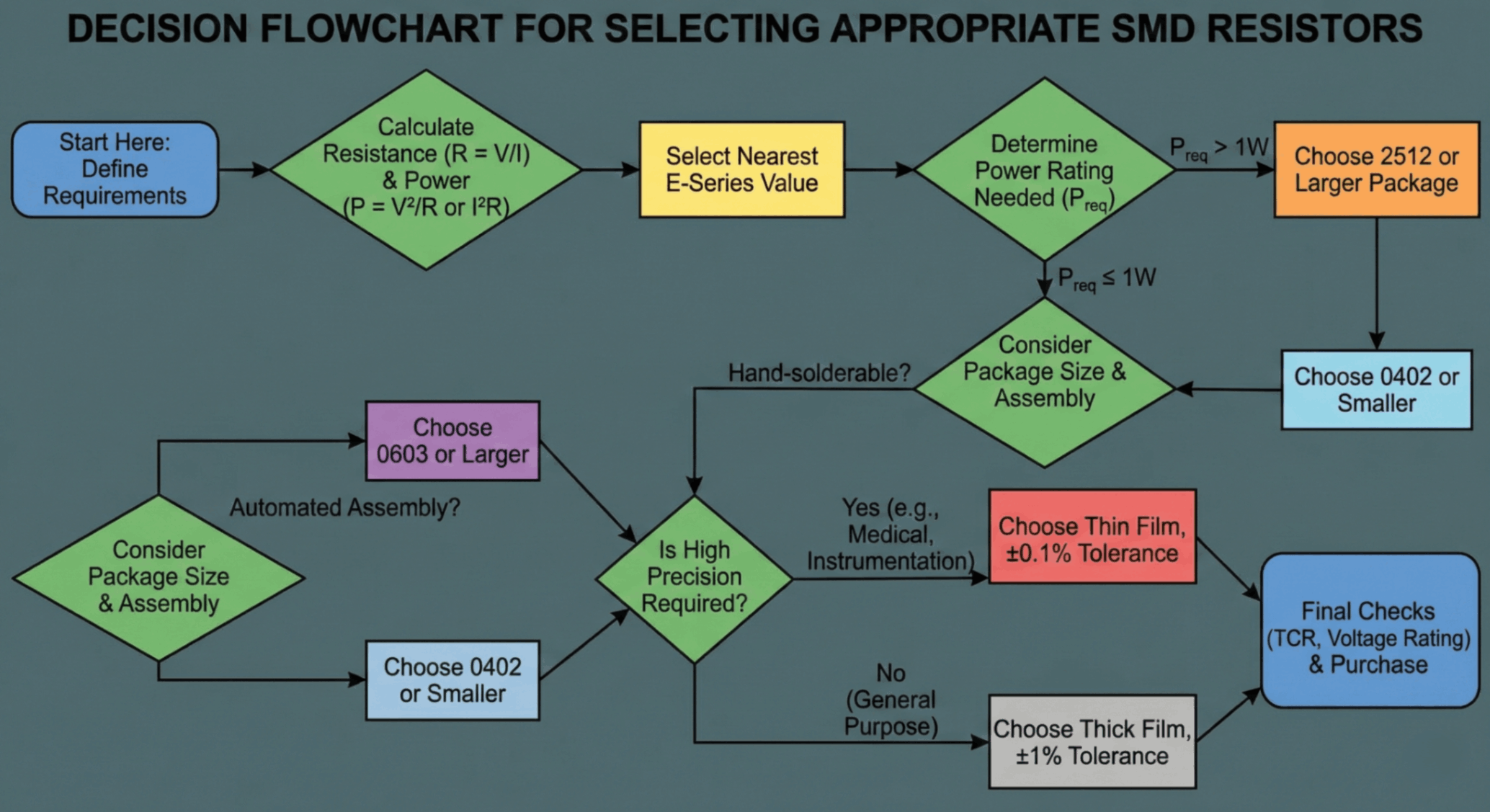
Decision flowchart for selecting appropriate SMD resistors
Key Selection Criteria
Resistance Value:
Calculate using Ohm’s law, then select the nearest standard value from the appropriate E-series.Power Rating:
Calculate the maximum power (P = V²/R or P = I²R), then choose a resistor with at least 2× that rating for better reliability and safety.Package Size:
- Prototyping: Stick with 0603 or larger
- Production: Choose smallest meeting power requirements
- High-power: Larger packages non-negotiable (2512 handles 1W vs 0.1W for 0603)
Tolerance:
±1% is suitable for most applications. Use ±0.1% only for precision circuits where accuracy is critical.Temperature Coefficient (TCR):
Standard thick film resistors (100–200 ppm/K) work for most uses. Choose thin film resistors (<50 ppm/K) for precision circuits with temperature variation.Voltage Rating:
Smaller packages have lower voltage limits. Always check the datasheet, especially for high-voltage circuit designs.Quick Selection Guide
- General electronics: 0603/0805 thick film, ±1% tolerance
- Precision instruments: Thin film, ±0.1% tolerance, low TCR
- High-power: Large packages (1206+), significant derating
- Compact devices: 0402 or smaller (requires proper equipment)
Consider your assembly capabilities and field serviceability needs.
Testing SMD Resistors
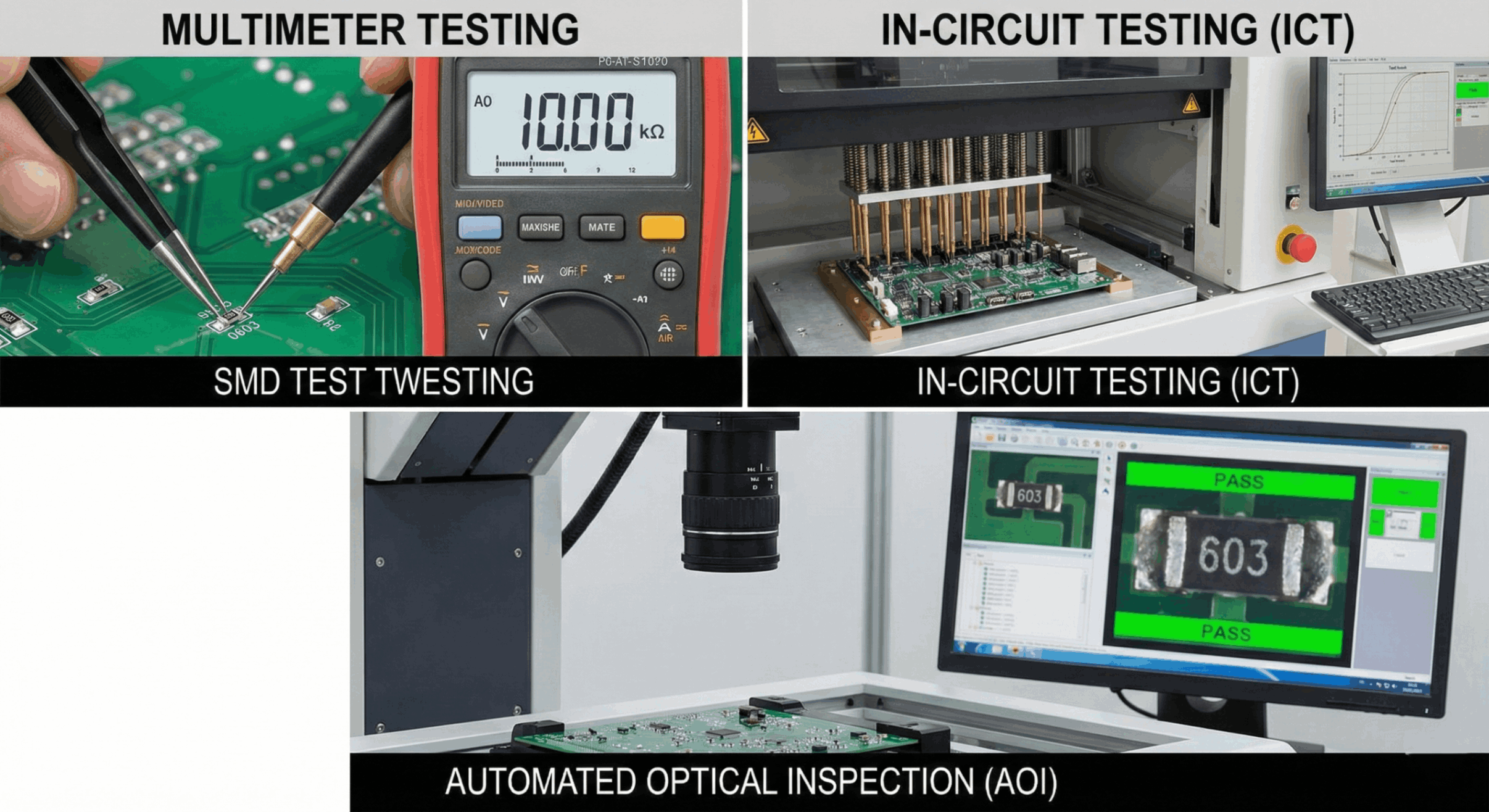
Various methods for testing SMD resistors
Multimeter Testing:
Use fine-tipped probes or SMD test tweezers for accurate measurement of discrete components.In-Circuit Testing:
Can be tricky due to parallel paths—often requires disconnecting one end of the resistor or using specialized test equipment.Production Methods:
Automated Optical Inspection (AOI) verifies component placement and solder quality, while In-Circuit Testing (ICT) measures actual resistor values during production.Frequently Asked Questions
How do I identify an unmarked SMD resistor?
Use a multimeter with fine-tipped probes. Check design files or the bill of materials if available. Keep components organized to avoid this issue.Can I use a through-hole resistor instead?
Yes, for prototyping or emergency repairs with appropriate values. However, it’s not suitable for high-frequency applications or production use.What causes failures?
Exceeding the power rating (most common), voltage spikes, PCB flexing, poor soldering, and extreme environmental conditions.How small can I hand-solder?
0603 packages are reliably hand-solderable with proper tools. 0402 is challenging. Smaller sizes usually require hot air reflow or a reflow oven.Thick film vs thin film — which to choose?
Choose thick film for general-purpose use (cheaper, ±1–5%). Use thin film when precision matters (±0.01–0.1% tolerance with better temperature stability).Making Your Decision
The best SMD resistor matches your specific needs. Start with 0603 or 0805 thick film resistors with ±1% tolerance for general applications-they’re the sweet spot of performance, cost, and ease of use.
Specify tighter tolerances and thin film construction only where precision genuinely matters. Choose package size based on power requirements and assembly capabilities. Always verify with real-world testing.
The right choice becomes second nature with experience. Take your time, ask questions, and consult with experienced engineers. These tiny components are crucial to modern electronics – understanding them well will serve you throughout your career.
Whether you’re building your first prototype or designing production electronics, SMD resistors enable the compact, reliable designs that power our modern world.
Popular Tags
SMDResistors
SurfaceMountComponents
ElectronicsEngineering
PCBDesign
ElectronicComponents
CircuitDesign
EmbeddedSystems
ElectronicsProjects
PCBAssembly
ComponentSelection
ThickFilmResistors
ThinFilmResistors
0603Resistor
0805Resistor
SMTComponents
ElectronicsManufacturing
HardwareEngineering
1206resistor
EmbeddedHardware
